
T2Train to THINK
G
Page G

Reading: Train to THINK

Start
Warmer

Before Reading: What do you say when something feels difficult?

遇到不会做的题、进不了球队、学不会一个技能时,我们通常会怎么说?

What changes when we add “yet”?

yet 让这句话从“我不会”变成“我现在还不会,但以后可能会”。
1
Before Reading

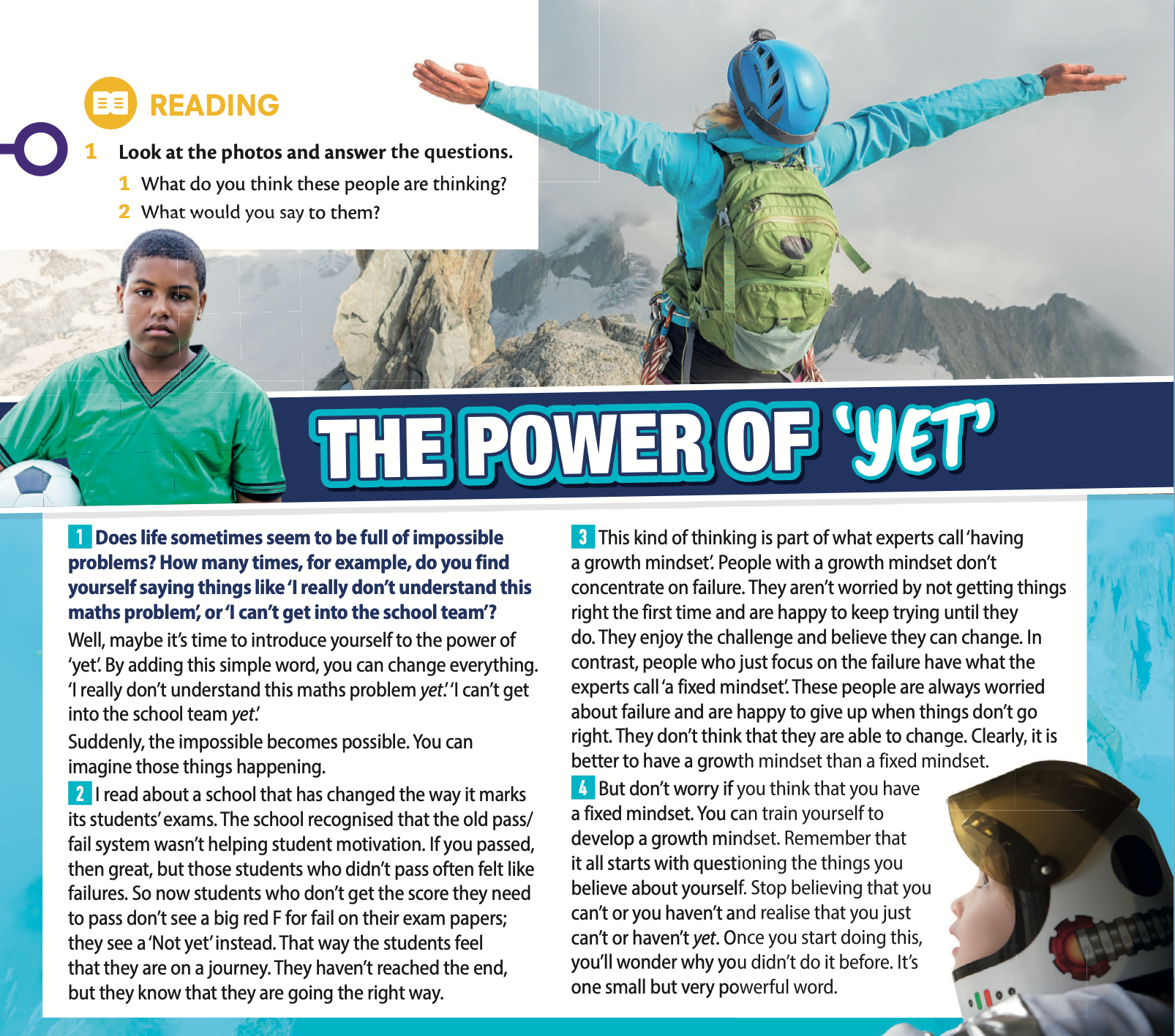
Look At Photos And Predict

Look at the photos and answer the questions.

Unit 2 page 24 Exercise 1 photos

1 What do you think these people are thinking?

2 What would you say to them?

THINK
Train to THINK

How do we understand the main idea?

你会先看什么来判断文章主旨?

阅读主旨时,不要一开始就卡在细节。

可以先看:

1. 标题 title

2. 开头 first paragraph

3. 重复出现的关键词 repeated words

4. 图片 pictures

5. 每段主要在讲什么 paragraph topic

这一步是为了判断文章类型和大意,再进入细节题。

4
First Listening / First Reading

Exercise 4

先听 / 读一遍,判断这篇文章主要是在做什么。

Choose the best description of this text.

A an adventure story to entertain the reader

B an ad to sell the reader something

C a magazine article to give the reader information

D a letter to persuade the reader to do something

Read
Reading Text Area

The Power Of “Yet”

Track 2.04

THE POWER OF ‘YET’

1Does life sometimes seem to be full of impossible problems? How many times, for example, do you find yourself saying things like ‘I really don’t understand this maths problem’, or ‘I can’t get into the school team’? Well, maybe it’s time to introduce yourself to the power of ‘yet’. By adding this simple word, you can change everything. ‘I really don’t understand this maths problem yet.’ ‘I can’t get into the school team yet.’ Suddenly, the impossible becomes possible. You can imagine those things happening.

2I read about a school that has changed the way it marks its students’ exams. The school recognised that the old pass/fail system wasn’t helping student motivation. If you passed, then great, but those students who didn’t pass often felt like failures. So now students who don’t get the score they need to pass don’t see a big red F for fail on their exam papers; they see a ‘Not yet’ instead. That way the students feel that they are on a journey. They haven’t reached the end, but they know that they are going the right way.

3This kind of thinking is part of what experts call ‘having a growth mindset’. People with a growth mindset don’t concentrate on failure. They aren’t worried by not getting things right the first time and are happy to keep trying until they do. They enjoy the challenge and believe they can change. In contrast, people who just focus on the failure have what the experts call ‘a fixed mindset’. These people are always worried about failure and are happy to give up when things don’t go right. They don’t think that they are able to change. Clearly, it is better to have a growth mindset than a fixed mindset.

4But don’t worry if you think that you have a fixed mindset. You can train yourself to develop a growth mindset. Remember that it all starts with questioning the things you believe about yourself. Stop believing that you can’t or you haven’t and realise that you just can’t or haven’t yet. Once you start doing this, you’ll wonder why you didn’t do it before. It’s one small but very powerful word.

2
Detailed Reading

Exercise 2

Read and listen to the text and answer the questions.

THE POWER OF ‘YET’

1Does life sometimes seem to be full of impossible problems? How many times, for example, do you find yourself saying things like ‘I really don’t understand this maths problem’, or ‘I can’t get into the school team’? Well, maybe it’s time to introduce yourself to the power of ‘yet’. By adding this simple word, you can change everything. ‘I really don’t understand this maths problem yet.’ ‘I can’t get into the school team yet.’ Suddenly, the impossible becomes possible. You can imagine those things happening.

2I read about a school that has changed the way it marks its students’ exams. The school recognised that the old pass/fail system wasn’t helping student motivation. If you passed, then great, but those students who didn’t pass often felt like failures. So now students who don’t get the score they need to pass don’t see a big red F for fail on their exam papers; they see a ‘Not yet’ instead. That way the students feel that they are on a journey. They haven’t reached the end, but they know that they are going the right way.

3This kind of thinking is part of what experts call ‘having a growth mindset’. People with a growth mindset don’t concentrate on failure. They aren’t worried by not getting things right the first time and are happy to keep trying until they do. They enjoy the challenge and believe they can change. In contrast, people who just focus on the failure have what the experts call ‘a fixed mindset’. These people are always worried about failure and are happy to give up when things don’t go right. They don’t think that they are able to change. Clearly, it is better to have a growth mindset than a fixed mindset.

4But don’t worry if you think that you have a fixed mindset. You can train yourself to develop a growth mindset. Remember that it all starts with questioning the things you believe about yourself. Stop believing that you can’t or you haven’t and realise that you just can’t or haven’t yet. Once you start doing this, you’ll wonder why you didn’t do it before. It’s one small but very powerful word.

1 How does the word yet make a difference?

Because it changes the impossible into possible.

2 Why did the school change the way it graded exams?

They stopped putting F for fail on the exam papers and put “Not yet” instead.

3 How do people with a growth mindset behave?

They don’t concentrate on failure.

4 How are people with fixed mindsets different?

They focus on the failure.

5 What’s the first step needed to change from a fixed to a growth mindset?

Stop believing that you can’t do something and realise you just can’t do it yet.
3
Speaking

Make A Better-at List

Make a list of three things you would like to be better at. Work with a partner and discuss how you could achieve these things.

Idea bank

Schoolget better at Mathsimprove my English speakingremember more words
Skillsplay the guitarplay football betterdraw better pictures
Habitsconcentrate for longerread more bookspractise every day

Frame + typing practice

1 I’d like to be better at English speaking. I can improve by practising for ten minutes every day.

2 I’d like to be better at Maths. I can ask my teacher for help and try again.

3 I’d like to be better at the guitar. I can learn one song and practise every day.

Post
Post-reading

Post-reading: Understand the Text Better

THE POWER OF ‘YET’

Para 1Does life sometimes seem to be full of impossible problems? How many times, for example, do you find yourself saying things like ‘I really don’t understand this maths problem’, or ‘I can’t get into the school team’? Well, maybe it’s time to introduce yourself to the power of ‘yet’. By adding this simple word, you can change everything. ‘I really don’t understand this maths problem yet.’ ‘I can’t get into the school team yet.’ Suddenly, the impossible becomes possible. You can imagine those things happening.

Para 2I read about a school that has changed the way it marks its students’ exams. The school recognised that the old pass/fail system wasn’t helping student motivation. If you passed, then great, but those students who didn’t pass often felt like failures. So now students who don’t get the score they need to pass don’t see a big red F for fail on their exam papers; they see a ‘Not yet’ instead. That way the students feel that they are on a journey. They haven’t reached the end, but they know that they are going the right way.

Para 3This kind of thinking is part of what experts call ‘having a growth mindset’. People with a growth mindset don’t concentrate on failure. They aren’t worried by not getting things right the first time and are happy to keep trying until they do. They enjoy the challenge and believe they can change. In contrast, people who just focus on the failure have what the experts call ‘a fixed mindset’. These people are always worried about failure and are happy to give up when things don’t go right. They don’t think that they are able to change. Clearly, it is better to have a growth mindset than a fixed mindset.

Para 4But don’t worry if you think that you have a fixed mindset. You can train yourself to develop a growth mindset. Remember that it all starts with questioning the things you believe about yourself. Stop believing that you can’t or you haven’t and realise that you just can’t or haven’t yet. Once you start doing this, you’ll wonder why you didn’t do it before. It’s one small but very powerful word.