T2Unit 2 Writing

Schools with a Difference

Watch. Choose. Talk.

Which school interests you most?

What is different about it?

Actions:
  • study on a boat
  • learn at a railway station
  • use technology in class
  • study during floods
  • help children get an education
Describing words:
  • unusual
  • modern
  • useful
  • interesting

I’m interested in the Floating School because students can study on a boat.

It is different because children can still go to school during floods.

My School

From Special Schools to My School

What makes your school different?

What would you change to make your school more unique?

Ideas I Can Use

One special thing about my school is that we have many English activities.
This year, we’re doing more projects in class.
I’d like my school to have a bigger library.
It would help students read more books.

Writing: An Email About My School Routine

Study Ruby’s Email: Read → Find → Organise
4 ANALYSE Match the four paragraphs of Ruby’s email with the content.

1 INPUT Read Ruby’s email. Then answer the questions.

1 How does Ruby feel about her new class?

She’s enjoying it.

2 What does Ruby think of Nathan and why?

She thinks he’s cool and they have lots of fun together.

3 How does her work for school compare to last year?

She’s spending more time at school and she’s getting a lot more homework.

4 What subject does she get a lot of homework for, and how does she feel about it?

Art. She loves the projects.

5 Does Ruby think you’ve got less schoolwork than her?

No. She says, “I guess it’s not so different for you.”

2 Find sentences in the email where Ruby writes about these things. What tense does she use in those sentences? Why does she use it?

a asks how you feel about your new school

Are you enjoying your new school?

b talks about Nathan’s mother

His mother is working in the UK for two years, and the whole family have come over.

c compares school this year to last year

I’m spending more time at school than last year, and I come home at 5.45 three times a week.

d talks about the amount of homework this year

We’re also getting a lot more homework.

present continuous 现在进行时:表示现在或这一阶段正在发生的事情。

Exercise 3

Build the Sentences

3 Put the words in the right order. Write the sentences. What tense are they in and why?

1 new / too / class / kid / There’s / a / my / in

There’s a new kid in my class too.
这里用 present simple / there is 来介绍班里有一个新同学,说明现在班级里的情况。

2 a week / at / three times / come home / 5.45 / I

I come home at 5.45 three times a week.
three times a week 表示经常发生的安排,所以用 present simple。

3 love / projects / I / class / But / the / do / this / in / we

But I love the projects we do in this class.
love 表达现在的感受;we do in this class 说明这个班里常做的 projects。
present simple 一般现在时:表示经常发生的事情,或现在比较稳定的情况。

Now use the same idea to write about this year.

Use the Language

Write About My School Life

My Class and School Life 我的班级和学校生活

From Ruby’s email: I’m in a class with all my friends again.

People:
  • some of my good friends
  • friendly classmates
  • a new classmate
  • helpful teachers
School life:
  • English speaking activities
  • interesting projects
  • sports clubs
  • reading time
  • group work

Changes This Year 今年的变化

From Ruby’s email:
I’m spending more time at school than last year.
We’re also getting a lot more homework.

present continuous 现在进行时
表示现在或这一阶段正在发生的事情。

Study and time:
  • spending more time at school
  • spending more time practising English
  • reading more English books
Class activities:
  • doing more projects
  • having more speaking activities
  • working in groups more often
Schoolwork:
  • getting more homework

Subjects and Feelings 学科与感受

From Ruby’s email: But I love the projects we do in this class!

Subjects:
  • English
  • Maths
  • Science
  • Art
  • PE
  • Music
Positive reasons:
  • it is interesting
  • it is useful
  • I can be creative
  • I enjoy the projects
  • I am good at it
Negative reasons:
  • it is difficult
  • there is a lot of homework
  • I am not good at numbers
  • I find it hard to remember things

Questions and Ending 回问与结尾

Questions:
  • What subject do you like most?
  • What is your new class like?
  • Do you have a lot of homework this year?
  • Are you enjoying your new school?
Endings:
  • Write soon!
  • Write back soon!

Write soon!

Exercise 5

Plan My Reply

Plan Your Email

5 PLAN Read Ruby’s email again. Make notes with your own ideas on how:

1. Reply to Ruby

回应 Ruby 开头的问题

a. to answer the question in her introduction
2. Describe my class

我的班级或学校生活

b. to describe your new class
(new school? classmates?)
3. Compare this year with last year

今年的变化

c. to compare your work this year to last year’s
4. Say how I feel about my subjects

学科与感受

d. to say how you feel about your subjects
(any subjects you particularly like / don’t like? Why?)
5. Ask Ruby a question and finish

回问与结尾

e. you could finish your email
(what do you want to know from Ruby?)

Reply sentence and signature

Use the sentences you wrote in “Use the Language”. Add only the opening reply and your name here.

Content ideas:
  • you like your new class
  • you have made a new friend
  • you are enjoying your new school
  • you like your Art projects
Sentence starters:
  • I’m glad to hear that ...
  • It sounds great that ...
Draft assembled in the final email box. You can keep editing it there.

Write My Email

Exercise 6

6 PRODUCE Write an email to Ruby (about 200 words). Look at your notes from Exercise 5 and make sure you include all your ideas. Make sure you use the present simple when necessary.

My Email Checklist

My Reply Email 我的回复邮件

Hi Ruby,

Thanks for your email. I’m glad to hear that you like your new class.

I’m enjoying school this year, too. I’m in a class with some of my good friends, and we have lots of fun together. This year, I’m spending more time practising English because I want to speak more confidently. We’re also doing more projects in class.

My favourite subject is English because it is interesting and useful. I don’t really like Maths very much because some questions are difficult for me.

What subject do you like most at your new school? Do you have a lot of homework this year?

Write soon!

KET / PET Email Writing Tip
考试写作提示

KET / PET Email Writing Tip
考试写作提示

写回复邮件时,先确认这五件事:

1. 回应对方的问题或信息。
Answer the question or respond to the information in the email.

2. 覆盖题目要求的所有要点。
Include all the required points.

3. 用适合朋友之间邮件的语气。
Write in a friendly style.

4. 不只写答案,适当补充原因或细节。
Add a reason or detail where useful.

5. 写完检查拼写、时态和结尾。
Check spelling, basic tenses and your ending.

KET 写作通常更短,重点是完整回应提示点。
PET 邮件需要展开得更充分,内容组织和细节更重要。

Writing Map
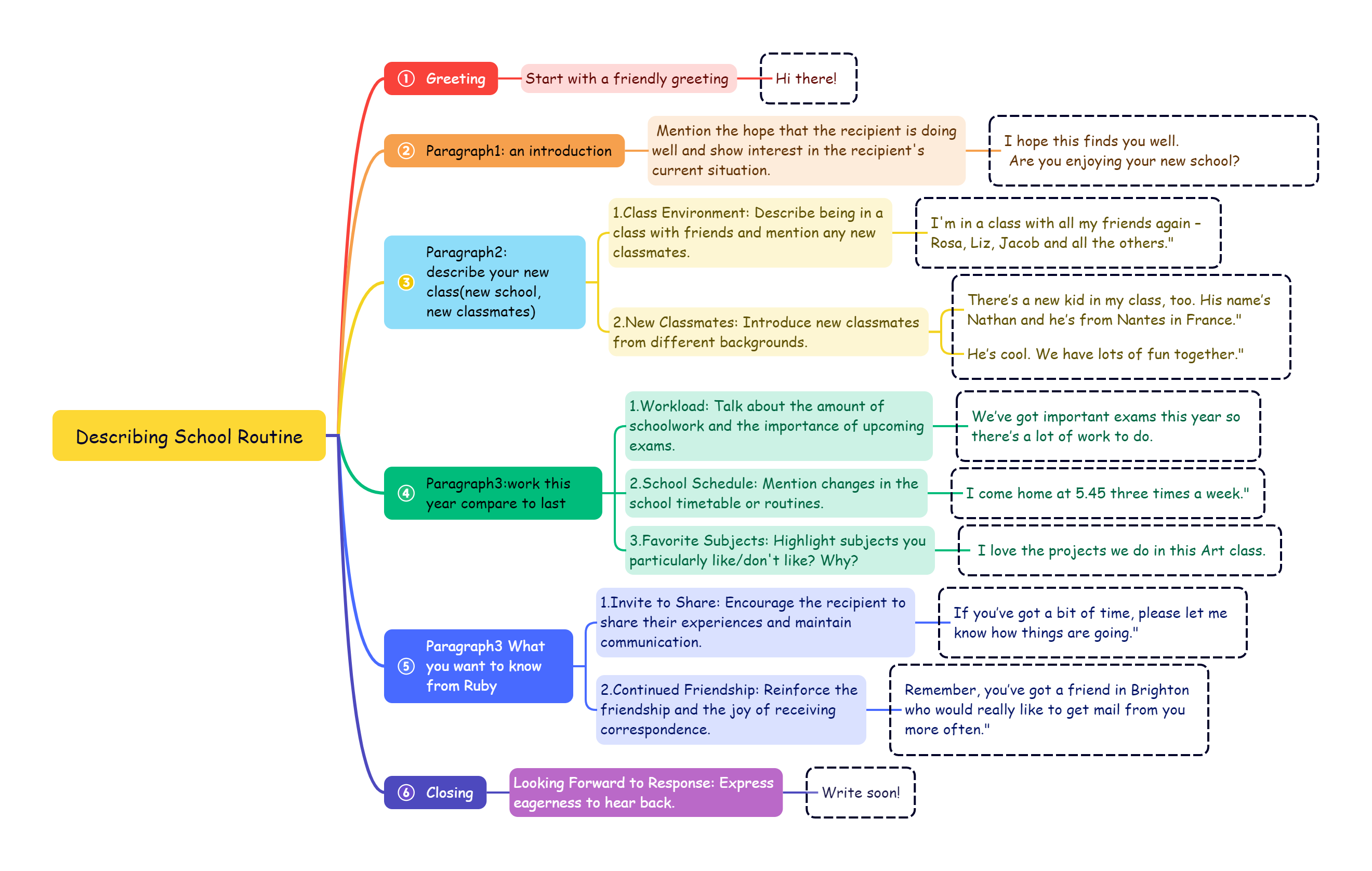
Describing My School Routine
写作思维导图:描述我的学校生活

完成邮件后,可以用这张图检查自己是否已经写到班级、课程、变化、感受和结尾提问。

Writing map for describing my school routine